



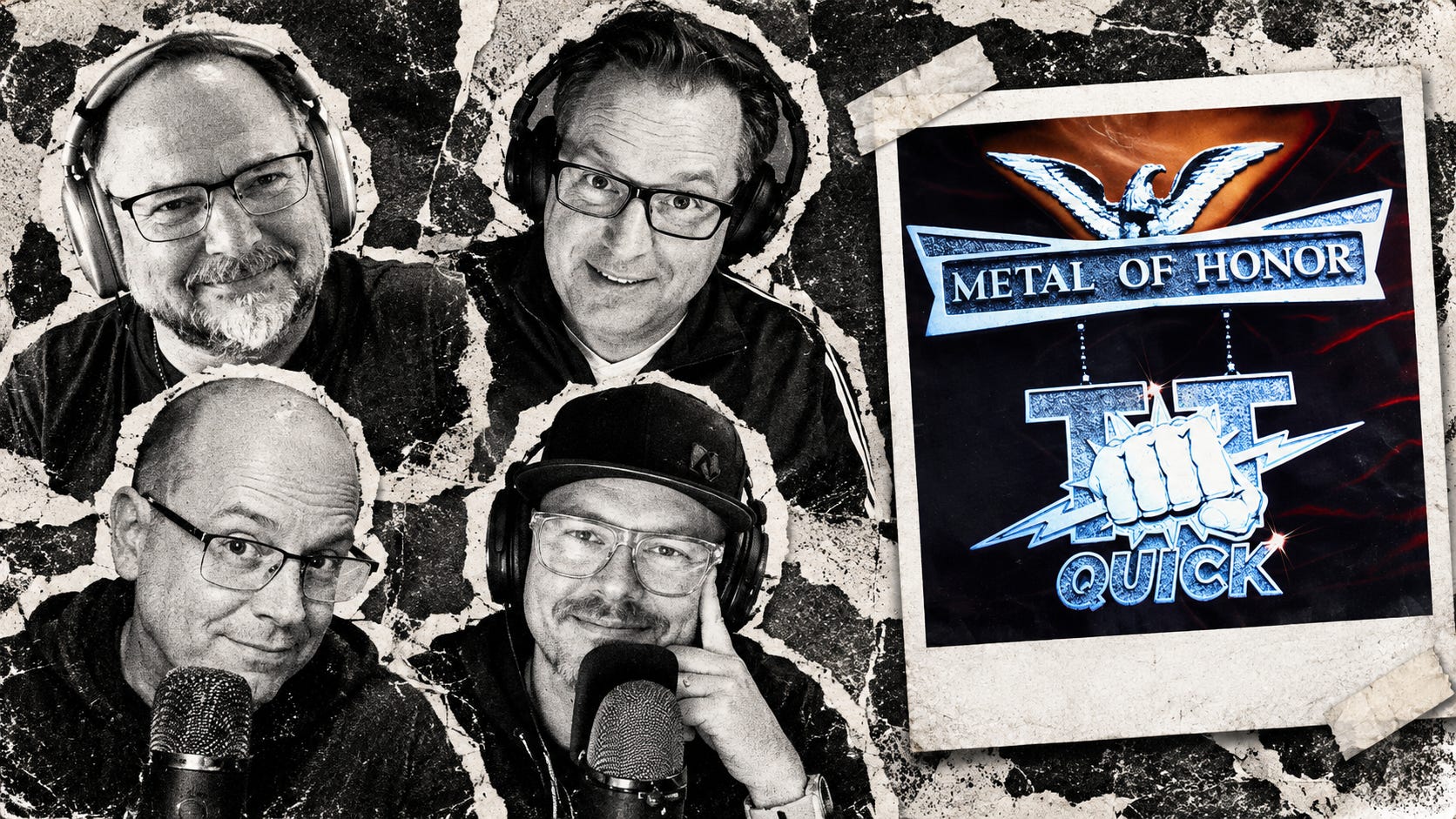
Returning Board of Directors member Patrick Testa brought us T.T. Quick’s Metal of Honor, a 1986 favorite that helped him find confidence as a teenager. We found a record caught between classic metal conviction, unexpected musical turns, and a voice that still starts arguments. Want to bring YOUR favorite lost album to the table? Suggest it for a future episode.
What if the songs that saved an album also confused its identity?
That question kept coming back as we worked through Metal of Honor. Not because T.T. Quick couldn’t play. Not because they lacked hooks. The problem, or the pleasure, depending on which side of our conversation you land, is that they could do several things convincingly.
There’s muscular, chest-out metal here. There’s boogie. There are melodic turns that seem ready to wander toward a different audience. And underneath the familiar ingredients, there are guitar passages that make us stop and listen again.
For Patrick, none of this started as an argument about genre. This was a record that made being sixteen feel a little less powerless. That’s a different kind of credibility, and a harder thing to measure than whether every song belongs on the same album.
Before You Could Hear Everything, You Had to Find Something
Remember knowing what a band looked like before you knew what they sounded like?
You’d see the ads, recognize the logo, study the album cover. But hearing the music was another matter. You waited for a request to get played. Stayed up for the metal videos. Turned toward the weaker end of the dial, hoping the signal would hold long enough to hear something worth remembering.
And when something finally grabbed you, you had to catch the band’s name.
That was the thrill and the frustration. There might be a record out there that sounded exactly like what you needed, but somebody had to play it first. Or you had to take a chance with the money in your pocket.
A cassette was a commitment. You could spend a lot of time looking at one before deciding to bring it home. An album cover might promise everything you loved about metal without giving you any real idea of what was waiting on side one.
That’s why a station like Z-Rock could feel so important. Here were the bands you’d been reading about, finally coming through the speakers. Another unfamiliar song was a reason to keep listening, even if it meant driving around a little longer.
That’s how Metal of Honor entered Patrick’s life. He remembers hearing the title track around early 1987 and going looking for the record. Others among us recognized the artwork but had never heard the album. Same era, overlapping tastes, completely different paths through the music.
We all have records like that. The one you assumed everybody owned until you discovered hardly anyone knew it. The one that still brings back the room where you played it, or the feeling of finally finding something that seemed meant for you.
Coming back to those albums isn’t just asking whether they hold up. It’s remembering why we held on.
A Bar Band With More Than Bar-Band Ambition
T.T. Quick came out of New Jersey’s competitive cover-band circuit, forming in 1979. They became part of the early Megaforce Records story, alongside a roster that included Metallica, Anthrax, and Overkill. Their self-titled EP arrived through the Avalanche imprint in 1984, followed by Metal of Honor on Island/Megaforce in 1986.
That history changes the picture a little. It’s easy to hear “regional hard rock band” and imagine a record made at the edge of the industry. This one had serious recording talent attached.
Eddie Kramer, Michael Wagener, Alex Perialas, and Rob “Wacko” Hunter appear in its track-specific production credits. Kramer mixed the album. That doesn’t tell us what the budget was, or prove anyone expected a breakthrough, but it does tell us this wasn’t a casual recording exercise.
The lineup was Mark Tornillo on vocals, David DiPietro on guitar, Walt Fortune on bass, and Erik Ferro on drums. DiPietro’s wider reputation adds another connection: he mentored Zakk Wylde and Dave Sabo.
We hear that ability in the arrangements, not just in an impressive résumé. The band can hit hard, then slip something less predictable between the blows. The question is whether that flexibility gives the album its personality or keeps its personality from settling.
The Most Interesting Stuff Happens Between the Lines
Our strongest case for this record begins with the parts that don’t behave exactly as expected.
The title track brings an early Mötley Crüe comparison into the room, especially in the vocal phrasing. But we also hear a heavier physical presence underneath it. Familiar swagger, more weight behind the punch.
Then “Front Burner” and “Hard as Rock” start complicating the picture. Picking figures interrupt the more straightforward metal framework. They’re brief, but they change the texture. To our ears, some of those touches resemble things we associate with later alternative rock. That’s a listening comparison, not a claim that T.T. Quick secretly invented the next decade.
“Child of Sin” makes the argument more forcefully. Its muted guitar attack, shifts in feel, and darker atmosphere give us something beyond a familiar riff and a shouted chorus. The record can move into quieter or more spacious passages without simply following the standard soft-opening-into-heavy-song route.
Do those changes deepen the songs? Sometimes we think they do. Sometimes we want the band to stop rearranging the furniture and hit the riff again.
That disagreement is useful. A dynamic change can sound inventive on one listen and unnecessarily fussy on another. We don’t all want the same thing from a three-minute metal song.
Join the community if that’s your kind of argument. Paid members vote on future album polls, contribute ratings and comments to the conversation, and help decide which records become full episodes and companion posts. Member participation changes what we make, not just what appears beneath it.
One Voice, Two Very Different Reactions
There is no sensible way to write around Tornillo’s voice.
The rasp is central to this album’s identity. So is the fact that it can wear people down. In our conversation, the comparisons included Brian Johnson and Udo Dirkschneider. For some ears, that grain supplies exactly the conviction these songs need. For others, it makes an already forceful record feel exhausting.
We hear both reactions in the community feedback, too. Some listeners liked the band but struggled with the singer. Others found particular songs strong enough to overcome that resistance. The disagreement wasn’t simply about whether the musicians could play. It was about how long someone wanted that voice in their headphones.
The historical connection is especially neat: Tornillo became the singer of Accept in 2009. Listening backward from that role makes T.T. Quick easier to place, but it shouldn’t reduce this record to an audition tape for a later career.
We also split over the production. A listener suggested a modern recording approach might make the album hit harder. There’s another argument: the dry drums and raw guitar tones are part of what makes it appealing now. Less wash, more of the sensation that somebody has turned up an amplifier and means it.
Neither reaction needs correcting. The sound either pulls you closer to the performance or leaves you imagining a heavier version of it.
When Variety Becomes the Argument
Flip the record and the disagreement sharpens.
“Come Beat the Band” leans into a boogie feel that brought Dangerous Toys to mind during our discussion. “Queen of the Scene” opens another door, somewhere between melodic metal and a street-level sleaze-rock character. These aren’t songs we dismiss as badly played or poorly written. Quite the opposite. The band sounds confident taking those turns.
That’s what makes the argument interesting.
A song can work beautifully by itself and still interrupt the album around it. If the strongest identity here is that stern, empowering metal charge, the side trips can feel like interruptions. If the opening stretch feels too familiar, those same side trips become the reason to keep listening.
Then there’s “Glad All Over,” the Dave Clark Five cover. We recognized the stylistic shift before everyone recognized the source. It raised the familiar question of whether an older pop song, recast as hard rock, helps introduce a band or distracts from what makes it distinctive.
We can hear a commercial strategy in that choice without pretending we have documentation of the decision-making. The episode’s suspicions about who wanted a hit remain suspicions, not established label history.
The band followed with Sloppy Seconds in 1989, Thrown Together Live in 1992, and Ink in 2000. Its story continued, but this album remains the point where our questions about range, identity, and unrealized possibility meet most clearly.
The Verdict: What Do You Need This Record to Do?
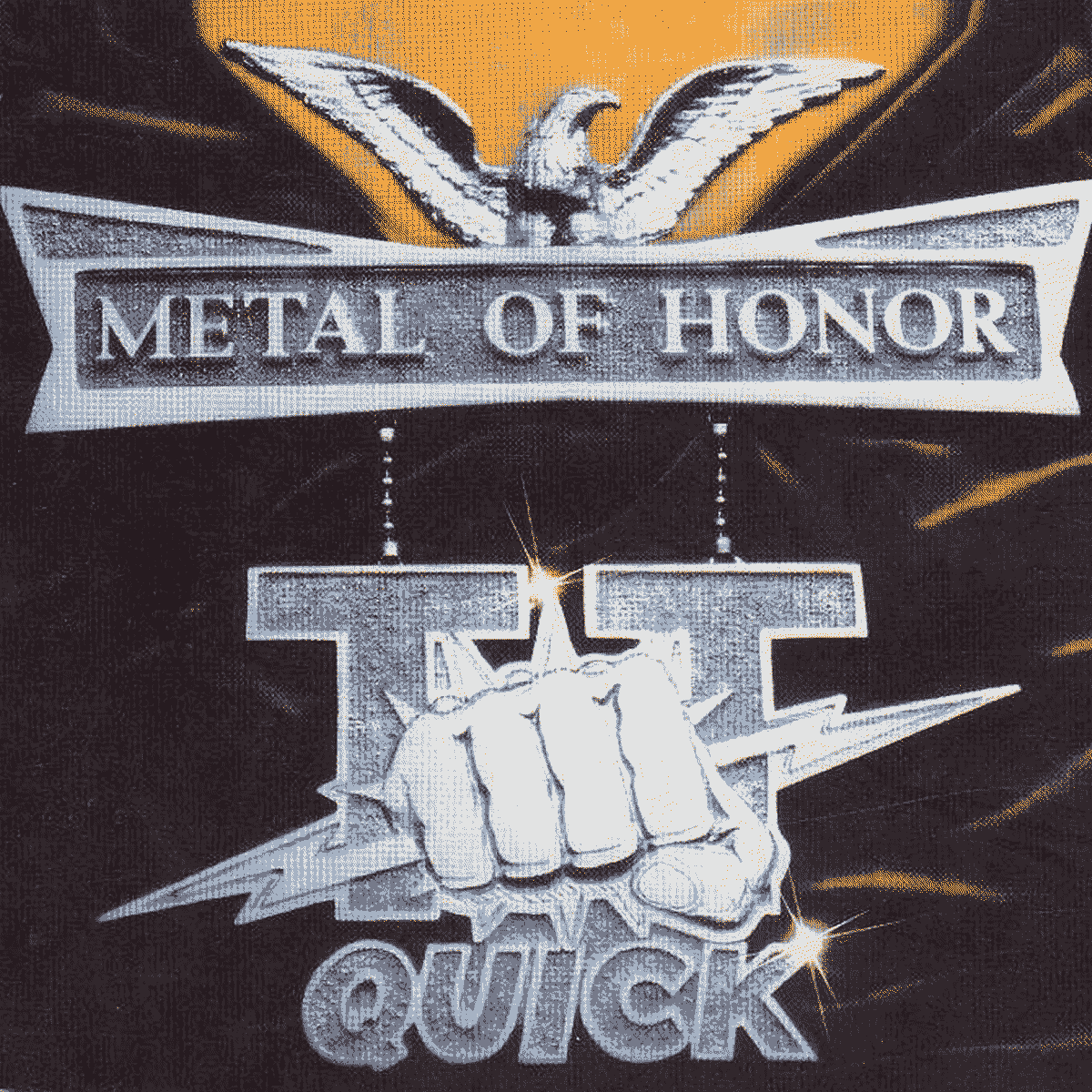
Patrick made a T.T. Quick emblem in high-school metals class.
Not a doodle in a notebook. An aluminum object based on the album’s imagery, originally imagined as something he could wear. It turned out too heavy for that plan. Decades later, he wanted to bring it out for this conversation and couldn’t find it.
We keep coming back to that story because it says something a rating can’t. This music mattered enough to become a physical object. The title track, “Child of Sin,” and “Hell to Pay” weren’t merely favorites. They helped him feel capable.
That doesn’t settle the album’s flaws. Our discussion still divides over the rasp, the sequencing, and whether its stylistic range adds character or weakens its center. Outside our conversation, the record has passionate advocates. A retrospective at Last Rites praises its traditional-metal force, riffs, and commitment while acknowledging uneven moments. The fan-review record at Encyclopaedia Metallum is more mixed, which is a useful reminder that cult affection isn’t consensus.
So what matters most to you: a coherent album identity or ten different chances to connect? Does Tornillo’s voice supply the conviction, or keep you outside the songs? Which track makes the strongest case that this band deserved more attention?
Listen to the episode for our full verdict, then leave a comment with your answer. And if another overlooked record did this job for you, bring it to a future episode. The records our community puts forward change the conversation we get to have.
Episode Highlights
01:31: Patrick’s pick, why Metal of Honor stayed with him from his teenage years.
03:12: Z-Rock memories, request lines, unfamiliar songs, and the work of finding metal.
12:52: T.T. Quick’s history, the New Jersey circuit and early Megaforce connection.
14:25: Players and production, the musicians and recording names behind the album.
20:11: Classic metal with unexpected turns, our first case for what works.
22:34: “Front Burner” and “Hard as Rock,” picking figures inside the heavy framework.
25:36: “Come Beat the Band,” boogie enters the conversation.
29:07: Metal in metals class, Patrick’s handmade T.T. Quick emblem.
39:38: Good songs, wrong album?, the argument over stylistic detours.
42:48: The side-A/side-B divide, why the same variety produces opposite reactions.
58:00: Final verdicts, where we land after weighing the songs, sound, and memories.


